I’ve been spending quite a bit of time on the super friendly Pirate Borg Discord server of late, one of the topics that I keep seeing is how 5E players often struggle with games where dying is actively encouraged. Lethality is the single greatest psychological barrier for players transitioning from modern tabletop RPGs to the Old School Renaissance (OSR).
In the world of games like Dungeons & Dragons 5th Edition, player characters are heroes from Level 1: powerful, resilient, and almost assuredly protected from anything but truly reckless play. Character death is seen as a failure of the Referee, or a catastrophic, campaign-derailing event.
Then you introduce a player to a game like Pirate Borg, where a single critical hit from a drunken thug can send their meticulously named character to a watery grave. The immediate reaction is often frustration, a feeling of being cheated, and a deep-seated reluctance to become attached to anyone they create.
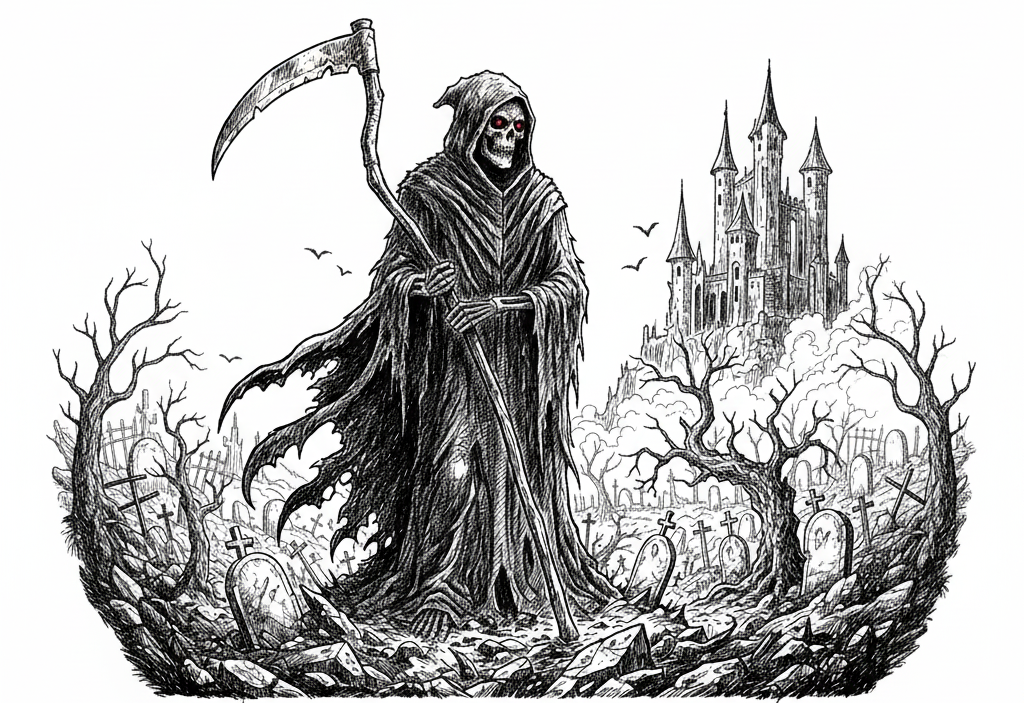
But here is the truth I learned: Character death is not a flaw; it is the central feature that makes the game work. It is the pressure that refines the player, not the character. If you’re struggling to move your table away from “heroic immunity,” you need to stop apologising for the Reaper and start explaining why he’s your best game master.
I. Death Elevates Player Skill
The number one problem with games that guarantee character longevity is that they often incentivise character abilities over player smarts. Why bother being clever when your cleric has a “Save or Die” spell, or you can just soak 80 points of damage?
When character death is a constant, looming threat, the player’s priorities immediately shift:
- From Combat to Evasion: The focus moves from “How do I defeat this foe?” to “How do I avoid this encounter entirely?” This is the core of OSR play: resource management, reconnaissance, and using the environment to your advantage.
- From Inventory to Initiative: Players suddenly care deeply about initiative, about surprise, and about the quality of their torch. Every decision outside of combat like whether to carry 20 extra gold or the extra coil of rope becomes a life or death tactical choice.
- The Power of Retreat: Death gives the glorious tactical choice of running away a sense of genuine triumph. Escaping with your lives and the scroll you came for is often a far greater victory than killing the monster.
The Lesson: Death is the filter. It kills the character’s ego and leaves only the player’s ingenuity.
II. Death Makes Attachment Consequential, Not Cruel
The hardest thing for new players to accept is that the hours spent creating a background feel wasted when the character dies quickly. I counter this with a simple truth: You are not building a static hero; you are building a liability.
- The Character Arc is the Session, Not the Campaign: In an OSR game, the investment is not in a five-year progression track; it is in the narrative arc of a single life. The player who dies fighting a losing battle to protect a retreat, or the one who survives twenty close calls only to be taken down by an ankle-biter—that is the story they tell years later.
- The Empty Slot Principle: This is what I learned most vividly on the Pirate Borg Discord. If you know you can roll up a new character in ten minutes (or use the random generator), the attachment shifts. You are not attached to the character; you are attached to the adventure. The replacement is just the next poor soul taking up the torch.
The quick and brutal demise of a character makes the survivors’ stories mean more. The fear of losing the team’s wizard is the most potent motivator for clever tactics, far better than any in-game debuff.
III. Death Fills the World with Wonder
Finally, lethal games feel more vast, more unpredictable, and genuinely more dangerous. When death is possible, the world feels real.
When a player’s character is invincible, the greatest monsters in the module are just complex puzzles to solve. When a player knows their character is fragile, every monster becomes an object of genuine fear and awe.
- A Dragon is a Disaster: The players don’t ask, “What is its HP?” They ask, “What is its lair like? What does it eat? How can we steal its eggs while it’s out?” The danger forces engagement with the environment and the creature’s ecology, rather than just its stat block.
- The Town is a Haven: Lethality also changes the perception of safety. The tavern, the blacksmith, and the walls of the city are not just shops; they are a cherished, necessary respite from a world that actively wants you dead.
So, when a player complains about death, smile. You are teaching them the core philosophy of OSR: You are not a hero yet. You are an adventurer. And adventurers must use their brains, not their hit points, to survive. The Reaper is just the harsh teacher ensuring that every victory is genuinely earned.